Cooling log template for restaurants
Cooked TCS food must cool from 135°F to 70°F within 2 hours and to 41°F or less within 6 hours total (FDA Food Code 2026, §3-501.14(A)). Food made from room-temperature ingredients must reach 41°F within 4 hours (§3-501.14(B)). Log that reading in the 6-hour column. This log in °F and Letter size records the time and temperature at each check, and we send it by email.
A template from Patrono, the food safety, scheduling and food cost app for US restaurants.
Updated
What §3-501.14 requires
The Food Code sets two limits for cooked food and one for food made from room-temperature ingredients. The log has a column for each check.
- 1.Within 2 hours. From 135°F to 70°F (§3-501.14(A)(1)).
- 2.Within 6 hours total. From 135°F to 41°F or less (§3-501.14(A)(2)).
- 3.Within 4 hours. Food made from room-temperature ingredients, such as reconstituted foods and canned tuna, to 41°F or less (§3-501.14(B)).
Is a cooling log required?
The Food Code treats routine temperature logs as inspection evidence, not a general written duty. Some local codes require them, for example Lee County, Illinois. And within four years of your regulatory authority adopting the 2026 Food Code, a written food safety management system with monitoring records becomes due (§8-201.15).
Ask the health department that issued your permit which edition it enforces. More in what the 2026 Food Code changes for restaurants.
How to cool food faster
§3-501.15 lists the cooling methods. New in 2026 is a depth of no more than 2 inches.
- shallow pans
- smaller or thinner portions
- rapid cooling equipment
- stirring the food in a container in an ice water bath
- containers that help heat transfer
- ice as an ingredient
- a depth of no more than 2 inches, new in 2026
The log
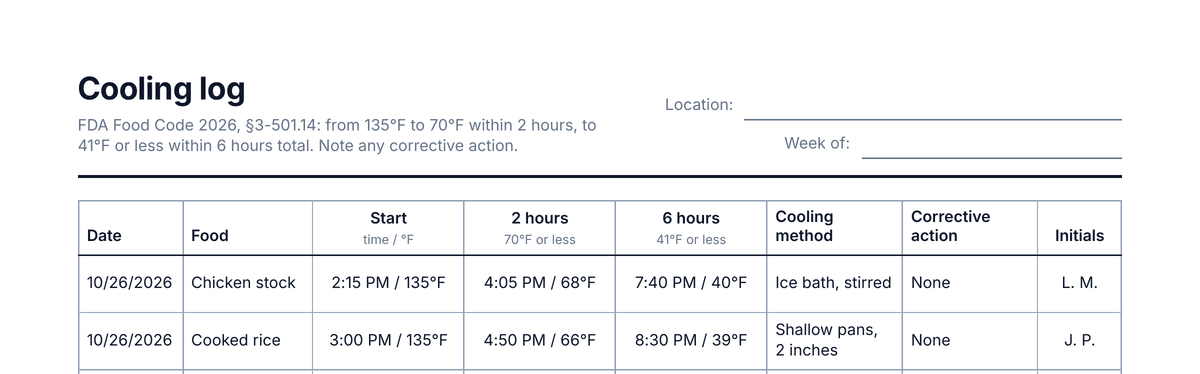
One line per batch, with the time and the temperature at the start, at 2 hours and at 6 hours. We email you a fillable PDF and a Word file, Letter size.
Cooling log
FDA Food Code 2026, §3-501.14: from 135°F to 70°F within 2 hours, to 41°F or less within 6 hours total. Note any corrective action.
Location: ____________________________
Week of: __/__/____
| Date | Food | Start time / °F | 2 hours 70°F or less | 6 hours 41°F or less | Cooling method | Corrective action | Initials |
|---|---|---|---|---|---|---|---|
| 10/26/2026 | Chicken stock | 2:15 PM / 135°F | 4:05 PM / 68°F | 7:40 PM / 40°F | Ice bath, stirred | None | L. M. |
| 10/26/2026 | Cooked rice | 3:00 PM / 135°F | 4:50 PM / 66°F | 8:30 PM / 39°F | Shallow pans, 2 inches | None | J. P. |
| __ / __ | __ / __ | __ / __ | |||||
| __ / __ | __ / __ | __ / __ | |||||
| __ / __ | __ / __ | __ / __ | |||||
| __ / __ | __ / __ | __ / __ |
The first two rows are examples.
Checked by (manager): ___________________________
Keep the records in one app
Patrono keeps food safety records, schedules and food cost for US restaurants in one app, no POS required. Start with 14 days. $0 today, cancel before day 15 and nothing is charged.
Frequently asked questions
What does it cost?
Nothing. Enter your email and we send you the files.
How fast must cooked food cool?
From 135°F to 70°F within 2 hours, and to 41°F or less within 6 hours total (FDA Food Code 2026, §3-501.14(A)). Food made from room-temperature ingredients, such as canned tuna, must reach 41°F within 4 hours (§3-501.14(B)).
Did the 2026 Food Code change the cooling limits?
No. FDA's list of changes does not include §3-501.14. New in 2026 is a cooling method, food at a depth of no more than 2 inches (§3-501.15(A)(7)), and a paragraph that lets your regulatory authority approve an alternative cooling method (§3-501.15(C)).
Do I have to keep a cooling log?
The Food Code treats routine temperature logs as inspection evidence, not a general written duty. Some local codes require them, for example Lee County, Illinois. And within four years of your regulatory authority adopting the 2026 Food Code, a written food safety management system with monitoring records becomes due (§8-201.15).
Is it in °F and Letter size?
Yes. Every temperature is in °F, and the log prints on Letter paper, one line per batch.