Food safety management system starter template for restaurants
Within four years of your authority adopting the 2026 Food Code, a written food safety management system has to be developed and maintained, run during all hours of operation, and be available on request (§8-201.15). This starter follows the Code’s own definition: written procedures, training plans and monitoring records.
A starter from Patrono, the food safety, scheduling and food cost app for US restaurants.
Updated
What §8-201.15 says
Within four years of your regulatory authority adopting the Code, a written food safety management system must be developed and maintained, implemented in the establishment during all hours of operation, and made available to the regulatory authority upon request (§8-201.15(A)). The section does not apply to establishments the regulatory authority deems to pose minimal risk, based on the nature of the operation and the extent of food preparation (§8-201.15(B)).
The Code does not list the contents yet. §8-201.16, “Contents of a Food Safety Management System,” reads “RESERVED.” So this starter follows the definition in §1-201.10: written procedures, training plans and monitoring records to control the operational steps in a food establishment that contribute to foodborne illness.
A written food safety management system was added since the 2022 Food Code (first published in FDA's 2024 Supplement), and the 2026 edition carries it. It also enters plan review: when you submit plans and specifications for review, the regulatory authority may ask for evidence that one is developed or being developed (§8-201.12(E)). More in what the 2026 Food Code changes for restaurants.
Who runs it
The Code ties the system to the duties of the person in charge in §2-103.11 (§8-201.15(A)(1)). Under §2-103.11, the person in charge maintains active managerial control of foodborne illness risk factors.
The person in charge must be a certified food protection manager (§2-102.12(A)), unless the regulatory authority deems the establishment to pose minimal risk (§2-102.12(B)). The starter has a table for the person in charge on each shift, one for each certificate, and a weekly review of the records.
What is in the file
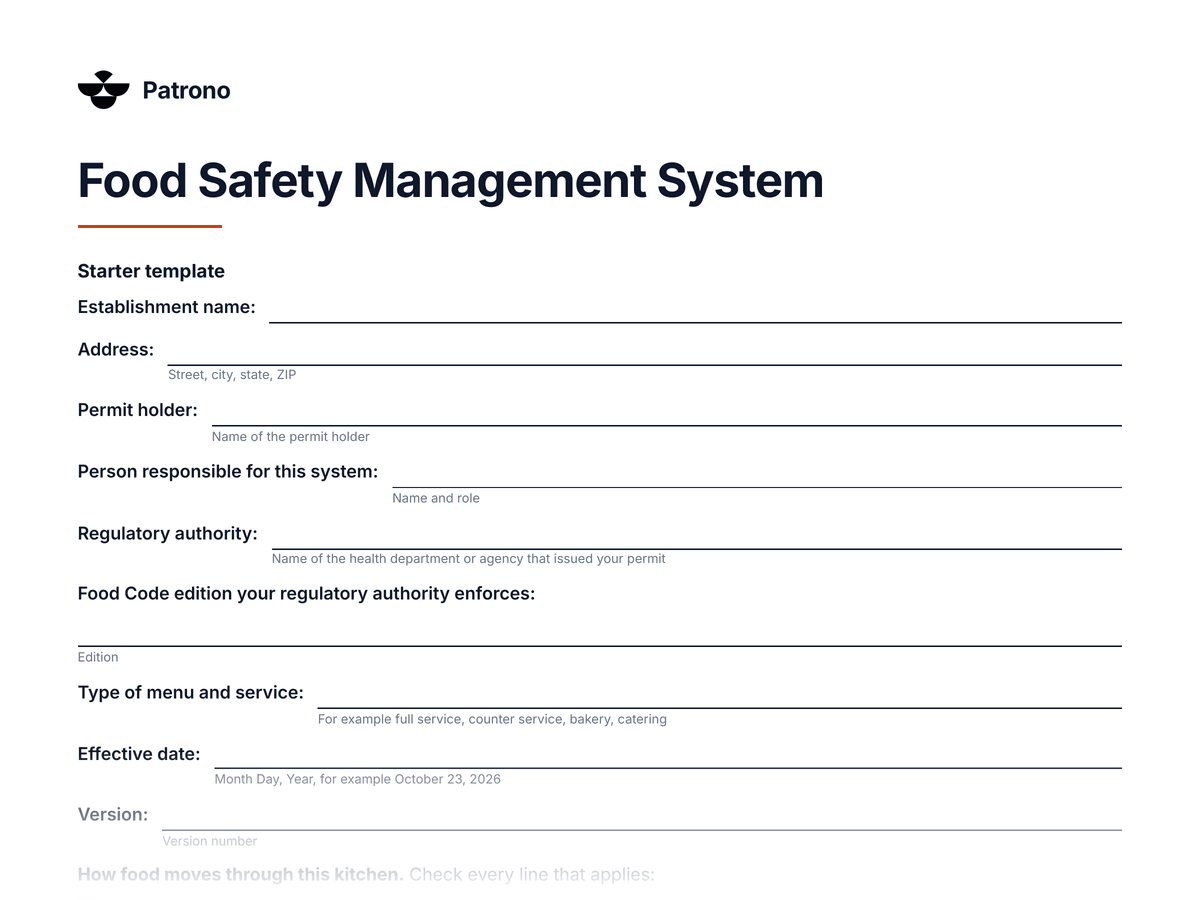
Seven sections, as a Word file to edit and a PDF of 10 Letter pages to read:
- Cover and scope: your establishment, the person responsible, your regulatory authority and how food moves through your kitchen.
- Roles: the person in charge on each shift, each certified food protection manager certificate, and a weekly records review.
- Written procedures: one block per step, from employee health and handwashing to cooking, cooling, date marking, cleaning, food allergens, vomiting and diarrheal events, and food defense.
- Training plan: who learns what and when, with a training roster.
- Monitoring records: which records you keep, how often, by whom and where, with a temperature log in °F.
- Corrective action and verification: what to do when a check fails, a corrective action log and a monthly self-inspection.
- Review: a yearly review date and a version history.
The starter prints no temperature or time limits. You write each limit from the Food Code edition your regulatory authority enforces, with its section number.
Keep the records in one app
Patrono keeps food safety records, schedules and food cost for US restaurants in one app, no POS required. Start with 14 days. $0 today, cancel before day 15 and nothing is charged.
Frequently asked questions
What is a food safety management system under the Food Code?
§1-201.10 defines it as a specific set of actions taken by employees to prevent foodborne illness risk factors, based on the type of operation, the type of food preparation and the food prepared. It includes written procedures, training plans and monitoring records to control the operational steps that contribute to foodborne illness.
When do I need a written FSMS?
Within four years of your regulatory authority adopting the 2026 Food Code (§8-201.15(A)). Ask the health department that issued your permit which edition it enforces. If you submit plans for review, the regulatory authority may already ask for evidence that a system is developed or being developed (§8-201.12(E)).
Is an FSMS the same as a HACCP plan?
Not under the Code’s definition. A food safety management system includes written procedures, training plans and monitoring records for the operational steps in your establishment (§1-201.10). The definition does not mention a HACCP plan. FDA lists HACCP-based tools from USDA and the Institute of Child Nutrition as a resource for building one (Annex 2).
Which records does an inspector ask for?
The system itself must be available to the regulatory authority upon request (§8-201.15(A)(3)), and FDA’s guidance in Annex 3 says it should be available for review during inspections. FDA’s model inspection form also checks that the person in charge is a certified food protection manager (item 2), and for a written employee illness policy and a written procedure for vomiting and diarrheal events (item 5, “Illness Documentation”).
Does a small restaurant need one?
§8-201.15 sets no size limit. It does not apply to establishments the regulatory authority deems to pose minimal risk of foodborne illness, based on the nature of the operation and the extent of food preparation (§8-201.15(B)). This starter is written for one restaurant and fills in section by section.
How do I get the file?
Enter your email on this page. The file arrives within a minute. There is no account to make.