Corrective action log template
When a temperature misses its limit, the inspector wants to know what you did about it, who did it and when. This one-page log records the problem, the fix, the recheck and who verified it, one numbered line per problem.
A template from Patrono, the food safety, scheduling and food cost app for US restaurants.
Updated
What's inside
- Numbered lines, so your cooling, holding and receiving logs can point to the fix.
- Columns for the reading and the limit, the action, who and when, the recheck and a "verified by" sign-off.
- A box of common fixes, each marked as Food Code, FDA guidance or good practice.
When the Food Code asks for corrective action records
The Food Code names corrective action records where your regulatory authority approves a special process.
- 1.A HACCP plan or a variance. Before you cure food, smoke it to preserve it or vacuum-pack TCS food, among other processes, you get a variance or submit a HACCP plan for approval (§3-502.11, §8-201.13).
- 2.Records of the fix. Then you keep records that show the necessary corrective actions are taken when a critical control point fails, and give them to the regulatory authority on request (§8-103.12(C)(4)).
- 3.Approved bare hand contact. You document that corrective action is taken when the procedures are not followed (§3-301.11(E)(7)).
- 4.Everywhere else, the limits. The Food Code sets the limits a check can miss, such as 41°F or less for cold holding (§3-501.16(A)(2)) and the cooling times of §3-501.14(A), and names no log for the fix.
What a corrective action looks like
A corrective action deals with the food and with the cause. FDA's guidance gives these examples.
- 1.Cooling misses 70°F. Cooked food above 70°F and two hours or less into cooling may be reheated to 165°F for 15 seconds and cooled again by a different method. More than two hours in, it is discarded (FDA Food Code 2026, Annex 5).
- 2.Cook it further. A hamburger that has not reached 155°F for 17 seconds can keep cooking until it does (Annex 4).
- 3.Discard it. Throwing out food that may not be safe is a corrective action too (Annex 4). Write what and how much.
- 4.Fix the cause. Repair the equipment or change the procedure, so the problem does not come back (Annex 5).
What the inspector checks
- That the people who watch the limits also take action when a limit is missed. Inspectors check whether monitoring and corrective action procedures exist and are followed (FDA Food Code 2026, Annex 5, 4(G)).
- When food is out of temperature, the inspector asks how long it was out and what happened to it, and checks that the manager's answer matches the staff's (Annex 5, 4(G)(5)). A dated fix with a name answers that.
- FDA's HACCP guidance lists what a verifier checks: the records are complete, the checks happen as often as planned, and "corrective action was taken when the person monitoring found and recorded that the critical limit was not met" (Annex 4, 3(F)(2)). That is the "Verified by" column.
- Corrective action records are the first of the five record types FDA lists for a food safety management system (Annex 4, 3(G)(2)).
Is a corrective action log required?
Where a HACCP plan or a variance applies, the Food Code asks for records that show the necessary corrective actions are taken, and you show them on request (§8-103.12(C)(4)). An approved bare hand contact procedure needs them too (§3-301.11(E)(7)). Elsewhere it sets the limits and names no log, and with a few exceptions, such as shellfish tags (§3-203.12) and fish freezing records (§3-402.12), it does not require formal records at retail (Annex 5). And within four years of your regulatory authority adopting the 2026 Food Code, a written food safety management system with monitoring records becomes due (§8-201.15).
Ask the health department that issued your permit which edition it enforces. More in what the 2026 Food Code changes for restaurants.
How to use the log
- 1.Write a line the moment a reading or check misses its limit, before you fix it.
- 2.Write the reading and the limit it missed, for example "44°F, limit 41°F".
- 3.Write what you did, who did it and when. If food was thrown out, say how much.
- 4.Recheck once the fix has had time to work, and write the time and the reading.
- 5.The person in charge checks that the fix worked and initials "Verified by". Other logs point to this one by line number.
More food safety logs
The log
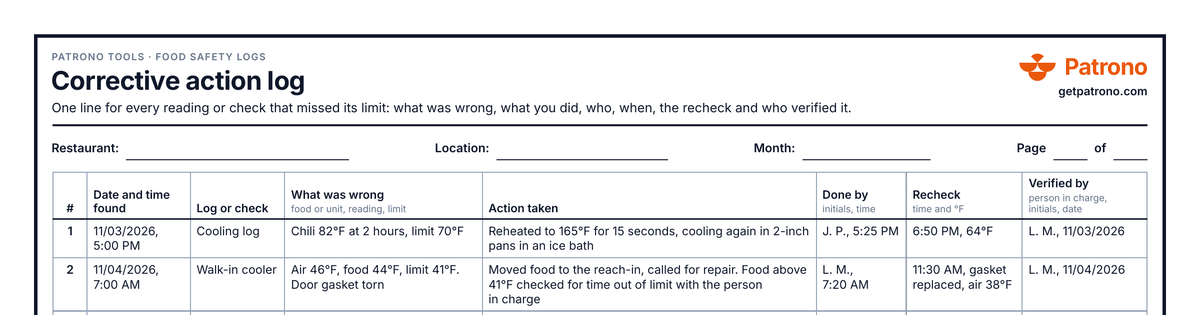
One numbered line per problem, with the date and time found, the log or check, what was wrong, the action taken, who did it, the recheck and who verified it. Enter your email and we send you the fillable PDF and the Word file, Letter size.
Corrective action log
One line for every reading or check that missed its limit: what was wrong, what you did, who, when, the recheck and who verified it.
Location: ____________________________
Month: ____________
| # | Date and time found | Log or check | What was wrong food or unit, reading, limit | Action taken | Done by initials, time | Recheck time and °F | Verified by person in charge, initials, date |
|---|---|---|---|---|---|---|---|
| 1 | 11/03/2026, 5:00 PM | Cooling log | Chili 82°F at 2 hours, limit 70°F | Reheated to 165°F for 15 seconds, cooling again in 2-inch pans in an ice bath | J. P., 5:25 PM | 6:50 PM, 64°F | L. M., 11/03/2026 |
| 2 | 11/04/2026, 7:00 AM | Walk-in cooler | Air 46°F, food 44°F, limit 41°F. Door gasket torn | Moved food to the reach-in, called for repair. Food above 41°F checked for time out of limit with the person in charge | L. M., 7:20 AM | 11:30 AM, gasket replaced, air 38°F | L. M., 11/04/2026 |
| 3 | |||||||
| 4 | |||||||
| 5 | |||||||
| 6 |
The first two lines are examples.
Page reviewed by (person in charge): ___________________________
The fix is part of the record
In Patrono, a reading out of range can't be saved until someone writes the corrective action, and the record keeps the name and the time. Nobody can change it after saving, and any month prints for the inspector with each fix beside its reading. Start with 14 days. $0 today, cancel before day 15 and nothing is charged.
Frequently asked questions
What does it cost?
Nothing. Enter your email and we send you the files.
Do restaurants have to keep a corrective action log?
The Food Code asks for corrective action records where a HACCP plan or a variance applies (FDA Food Code 2026, §8-103.12(C)(4)). Every restaurant will need a written food safety management system within four years of its health department adopting the 2026 Food Code (§8-201.15), and that system includes monitoring records (§1-201.10). Ask your health department which edition it enforces.
What should a corrective action record show?
FDA's guidance: clear instructions on who takes the action, the procedure to follow and when (Annex 4, 3(E)). A good record adds the reading, the limit it missed, the recheck and who verified that the fix worked (Annex 4, 3(F)).
What counts as a corrective action?
Throwing out food that may be unsafe is one. Cooking longer or reheating also counts, if it keeps the food safe (Annex 4, 3(E)). For cooling that runs late, FDA's guidance for inspectors is to reheat to 165°F for 15 seconds and cool again if the food is above 70°F at 2 hours or less into cooling. Past 2 hours and still above 70°F, or past 6 hours and still above 41°F, it goes out (Annex 5).
Can I keep this log in an app?
Yes. In Patrono, staff enter each reading by hand in the browser on any phone, tablet or computer, with a time and a name on every record. A reading out of range cannot be saved without a corrective action, and a saved temperature record cannot be changed.