Hot and cold holding temperature log
Hot food has to stay at 135°F or above and cold food at 41°F or below (FDA Food Code 2026, §3-501.16). This one-page °F log records the food you probed, the reading and the fix, one sheet per unit per month, with a box for New York's 140°F.
A template from Patrono, the food safety, scheduling and food cost app for US restaurants.
Updated
What's inside
- One line per check: date, time, the food you probed, the reading, within limit or not, the corrective action and initials.
- The limits printed on the sheet, with the roast exception, the NYC and New York State numbers and the section for each.
- A check-frequency line and a sign-off for the person in charge on every page.
What §3-501.16 requires
The Food Code sets one limit for hot holding, with one exception for roasts. The log has a column for the reading and one for the corrective action.
Some cities set a stricter limit: New York City requires hot food at 140°F or above (NYC Health Code §81.09(a)).
- 1.135°F or above. Hot TCS food on the line, in a steam table or in a holding cabinet (§3-501.16(A)(1)).
- 2.130°F or above for roasts. Roasts cooked to the roast chart, or reheated roast leftovers (§3-501.16(A)(1)).
- 3.41°F or below. Cold holding (§3-501.16(A)(2)).
- 4.Unit air at 45°F or below. Raw shell eggs not treated for Salmonella (§3-501.16(B)).
- 5.Not during prep or cooking. The 135°F limit does not apply while food is being prepared, cooked or cooled, or when you use time as a public health control (§3-501.16(A), §3-501.19).
What the inspector checks
- The inspector probes the food with a thermocouple or thermistor, tries to check every hot and cold unit, and does not use infrared (FDA Food Code 2026, Annex 5, 4(G)(5)).
- One food out of temperature marks hot or cold holding out on the report, unless you use time as a public health control for it (Annex 7, Guide 3-B, items 21 and 22).
- The inspector compares their calibrated thermometer with yours (Annex 5, 4(G)(4)). Yours has to be within ±2°F (§4-203.11(B)) and readily available (§4-302.12).
- When food is out of temperature, the inspector asks how long it has been out, and checks whether the manager's answer matches the staff's (Annex 5, 4(G)(5)). A log with times answers that question.
- With a few exceptions, records are not required at retail, so the inspector watches and asks questions too (Annex 5, 4(G)). A log with real times and initials backs up your answers.
Is a hot holding log required?
The Food Code sets the 135°F limit and says nothing about a log (§3-501.16): the inspector measures the food, and your log shows what the hot line held between visits. Some local codes do require one, for example Lee County, Illinois, for every hot holding unit (County Code §4-7-4(C)). And within four years of your regulatory authority adopting the 2026 Food Code, a written food safety management system with monitoring records becomes due (§8-201.15).
Ask the health department that issued your permit which edition it enforces. More in what the 2026 Food Code changes for restaurants.
How to use the log
- 1.Use one sheet per unit per month. Tick the limit for that unit.
- 2.Probe the food itself, in the center of the pan, with a calibrated food thermometer. On a steam table, also check the spot farthest from the heat, near the surface (FDA Food Code 2026, Annex 5).
- 3.Do not stir the food before you probe it, and do not use an infrared gun for this log. It reads only the surface (Annex 5).
- 4.Write every reading, in range or not. If it is out of limit, write the fix in the same line before you move on.
- 5.The person in charge reviews and signs each page.
More food safety logs
The log
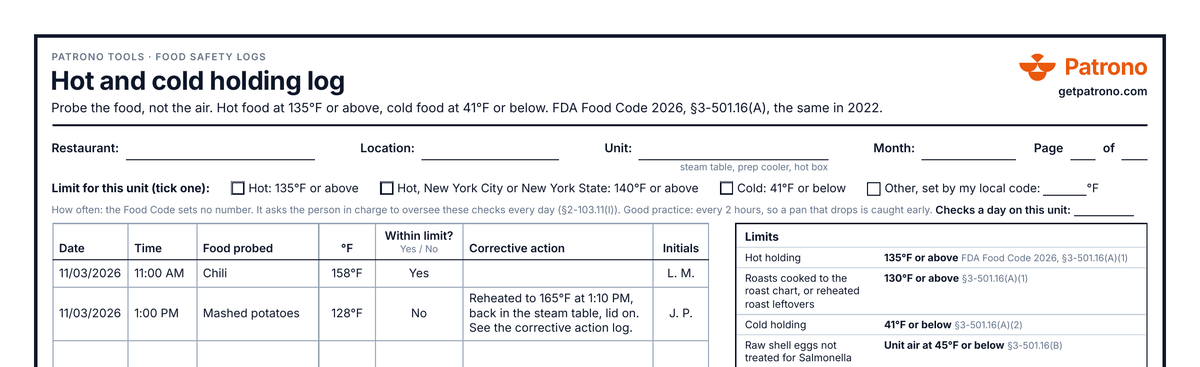
One line per check, with the date, the time, the food you probed, the reading in °F, within limit or not, the corrective action and initials. Enter your email and we send you the fillable PDF and the Word file, Letter size.
Hot and cold holding log
Probe the food, not the air. Hot food at 135°F or above, cold food at 41°F or below. FDA Food Code 2026, §3-501.16(A), the same in 2022.
Location: ____________________________
Month: ____________
| Date | Time | Food probed | °F | Within limit? Yes / No | Corrective action | Initials |
|---|---|---|---|---|---|---|
| 11/03/2026 | 11:00 AM | Chili | 158°F | Yes | L. M. | |
| 11/03/2026 | 1:00 PM | Mashed potatoes | 128°F | No | Reheated to 165°F at 1:10 PM, back in the steam table, lid on. See the corrective action log. | J. P. |
The first two lines are examples, for a hot unit.
Reviewed by (person in charge): ___________________________
Keep your holding checks in one app
Patrono keeps your hot and cold holding readings in °F, unit by unit. Every reading saves with a name and a time, and nobody can change it after saving. A reading out of range can't be saved without its corrective action, and you print any month for the inspector. Start with 14 days. $0 today, cancel before day 15 and nothing is charged.
Frequently asked questions
What does it cost?
Nothing. Enter your email and we send you the files.
What temperature does hot food have to be held at?
135°F or above (FDA Food Code 2026, §3-501.16(A)(1)). Roasts cooked to the Food Code roast chart may be held at 130°F or above. In New York City and the rest of New York State it is 140°F or above (NYC Health Code §81.09(a), 10 NYCRR §14-1.40(a)). Cold food stays at 41°F or below (§3-501.16(A)(2)).
How often should we check holding temperatures?
The Food Code sets no number. It asks the person in charge to oversee the checks every day (§2-103.11(I)), and FDA's HACCP guidance says to monitor often enough to make sure the limits are met (Annex 4). Every 2 hours is a common rule. San Diego County's own food temperature log asks for it.
Do we probe the food or read the unit's thermometer?
The food. Inspectors mark holding by the food's temperature taken with a calibrated food thermometer (Annex 7, Guide 3-B, items 21 and 22), and FDA tells them not to use infrared, which reads only the surface (Annex 5). The unit's thermometer reads the air (§4-204.112). That reading goes on a refrigerator or walk-in log.
Do I have to keep a hot holding log?
The Food Code sets the 135°F limit and says nothing about a log (§3-501.16): the inspector measures the food, and your log shows what the hot line held between visits. Some local codes do require one, for example Lee County, Illinois, for every hot holding unit (County Code §4-7-4(C)). And within four years of your regulatory authority adopting the 2026 Food Code, a written food safety management system with monitoring records becomes due (§8-201.15).
Can I keep this log in an app?
Yes. In Patrono, staff enter each reading in the browser on any phone, tablet or computer, with a time and a name on every record. A reading out of range cannot be saved without a corrective action, and a saved temperature record cannot be changed.