Food receiving log template
Cold deliveries have to arrive at 41°F or below, hot food at 135°F or above, and frozen food frozen (FDA Food Code 2026, §3-202.11). This one-page °F log records every delivery with its reading, its condition and whether you accepted or rejected it.
A template from Patrono, the food safety, scheduling and food cost app for US restaurants.
Updated
What's inside
- One line per delivery: supplier, food, type, reading, condition, accepted or rejected and why, initials.
- A key that prints each limit with its section, including shell eggs (the truck at 45°F air), milk at 45°F and live shellfish.
- A short how-to-probe box and a sign-off for the person in charge on every page.
What §3-202.11 requires
The Food Code sets a temperature for each kind of delivery. The log has a column for the temperature and one for your decision.
- 1.41°F or below. Refrigerated TCS food when received (§3-202.11(A)). A law on the food's distribution may set another temperature, as for milk and molluscan shellfish (§3-202.11(B)).
- 2.135°F or above. TCS food cooked and received hot (§3-202.11(D)).
- 3.45°F or less for raw eggs. Received in refrigerated equipment that keeps the air at 45°F or less (§3-202.11(C)).
- 4.Frozen stays frozen. Food labeled frozen and shipped frozen by a food processing plant is received frozen (§3-202.11(E)).
- 5.No sign of temperature abuse. TCS food arrives with no evidence of previous temperature abuse (§3-202.11(F)), and packages arrive in good condition (§3-202.15).
What the inspector checks
When a delivery arrives during the visit, FDA's guidance tells inspectors to (FDA Food Code 2026, Annex 5, 4(G)(2)):
- probe the food's internal temperature
- check that packages are intact
- look for signs of temperature abuse, such as large ice crystals in frozen packages
- check the truck and the food for cross-contamination
- watch how your staff handle the delivery, and how fast it gets into the cooler
- review receiving logs and other documents, labels and invoices, to confirm the food comes from an approved source and arrived at the right temperature
Also:
- If you accept a delivery and the inspector probes it above its limit at delivery, "food received at proper temperature" is marked out (Annex 7, Guide 3-B, item 12).
- Shellfish tags kept in order for 90 days, and fluid milk received pasteurized and at the right temperature (Annex 5, 4(G)(2)).
Is a receiving log required?
The Food Code sets the temperatures at receipt and says nothing about a duty to keep a log (§3-202.11). The inspector measures what arrives during the visit, and your log shows what arrived between visits. And within four years of your regulatory authority adopting the 2026 Food Code, a written food safety management system with monitoring records becomes due (§8-201.15).
Ask the health department that issued your permit which edition it enforces. More in what the 2026 Food Code changes for restaurants.
How to use the log
- 1.Check the delivery before the driver leaves. Probe cold and hot food, and look at frozen food for signs of thawing.
- 2.Write one line per food that needs temperature control, with its type letter, so the limit is clear.
- 3.For eggs, read the truck's air thermometer and write that number. Put the eggs into a unit at 45°F air or below right away.
- 4.Reject what is over its limit or arrives damaged, and write why. Tell the person in charge.
- 5.Keep shellfish tags on the container until it is empty, write on the tag the date the last one was served, and keep the tags in order for 90 days from that date (§3-203.12).
The log
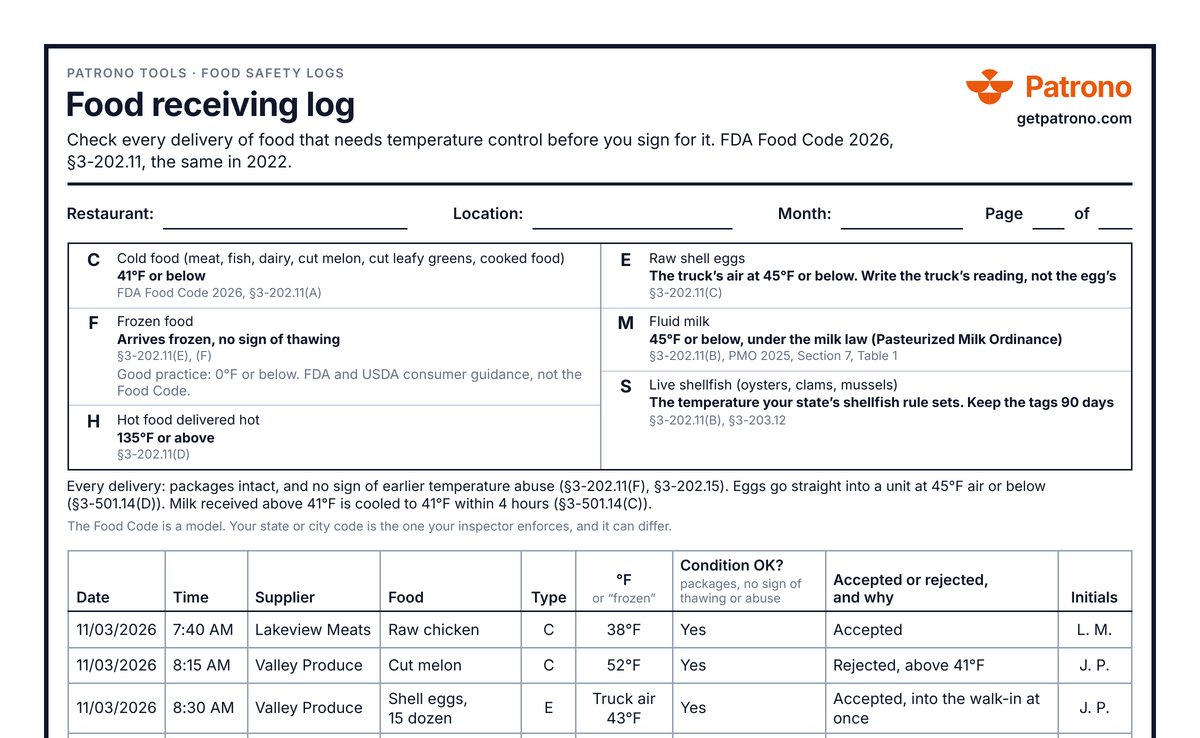
One line per item received, with the date, the time, the supplier, the food, its type, the reading in °F, the condition, accepted or rejected and why, and initials. Enter your email and we send you the fillable PDF and the Word file, Letter size.
Food receiving log
Check every delivery of food that needs temperature control before you sign for it. FDA Food Code 2026, §3-202.11, the same in 2022.
Location: ____________________________
Month: ____________
| Date | Time | Supplier | Food | Type | °F or “frozen” | Condition OK? packages, no sign of thawing or abuse | Accepted or rejected, and why | Initials |
|---|---|---|---|---|---|---|---|---|
| 11/03/2026 | 7:40 AM | Lakeview Meats | Raw chicken | C | 38°F | Yes | Accepted | L. M. |
| 11/03/2026 | 8:15 AM | Valley Produce | Cut melon | C | 52°F | Yes | Rejected, above 41°F | J. P. |
| 11/03/2026 | 8:30 AM | Valley Produce | Shell eggs, 15 dozen | E | Truck air 43°F | Yes | Accepted, into the walk-in at once | J. P. |
The first three lines are examples.
Reviewed by (person in charge): ___________________________
Keep this log in one app
Patrono keeps your receiving log in °F. Each delivery saves with the supplier, a name and a time, and nobody can change it after saving. A delivery out of range can't be saved without its corrective action, and you print any month for the inspector. Start with 14 days. $0 today, cancel before day 15 and nothing is charged.
Frequently asked questions
What does it cost?
Nothing. Enter your email and we send you the files.
What temperature should a delivery be?
Cold food that needs temperature control at 41°F or below, hot food at 135°F or above, and frozen food frozen, with no sign of thawing (FDA Food Code 2026, §3-202.11(A), (D), (E), (F)). 0°F for frozen food is good practice from FDA and USDA guidance, not a Food Code number.
Can eggs and milk arrive at 45°F?
Eggs: the Food Code limit is the truck's air, 45°F or below, and the eggs go straight into a unit at 45°F air or below (§3-202.11(C), §3-501.14(D)). Milk: the Food Code accepts the temperature set by the milk law (§3-202.11(B)), and the Pasteurized Milk Ordinance says 45°F or below. Milk received above 41°F is then cooled to 41°F within 4 hours (§3-501.14(C)). California excuses sealed pasteurized milk from that 4-hour step if it goes straight into a 45°F unit (Health and Safety Code §114002(e)).
What does an inspector check on deliveries?
FDA's inspection guidance lists the food's internal temperature, package condition, signs of temperature abuse such as large ice crystals, the truck, how your staff store the food, and your receiving logs and invoices (FDA Food Code 2026, Annex 5).
Do I have to keep a receiving log?
The Food Code sets the temperatures at receipt and says nothing about a duty to keep a log (§3-202.11). The inspector measures what arrives during the visit, and your log shows what arrived between visits. And within four years of your regulatory authority adopting the 2026 Food Code, a written food safety management system with monitoring records becomes due (§8-201.15).
Can I keep this log in an app?
Yes. In Patrono, staff enter each delivery by hand in the browser on any phone, tablet or computer, with a time and a name on every record. Temperature and food safety records cannot be changed after they are saved.