Sanitizer log template
Every kitchen that sanitizes with chemicals needs a test kit that measures the concentration in ppm (FDA Food Code, §4-302.14(A)). This one-page kitchen sanitizer log records each test: where, which chemical, the test strip reading in ppm, and what you did when it was off.
A template from Patrono, the food safety, scheduling and food cost app for US restaurants.
Updated
What is a sanitizer log?
A sanitizer log is the kitchen's record of each test of the sanitizer in its wiping-cloth buckets, sinks and dish machines: where, which chemical, the test strip reading in ppm, whether it was in range, what was done when it was not, and initials.
What's inside
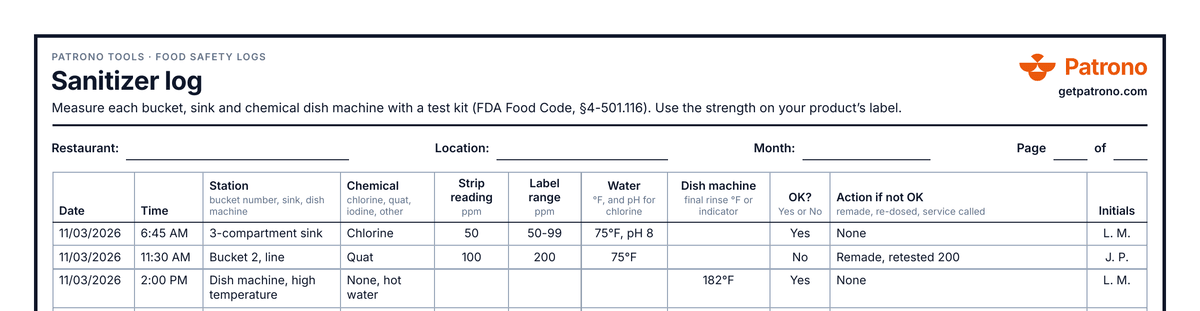
- One line per test: the date, the time, the station, the chemical, the strip reading and your label's range in ppm, the water temperature, the dish machine's final rinse, OK or not, the action and initials.
- The Food Code table for chlorine, iodine and quat printed on the sheet: the strength, the water temperature and the contact time, with the section numbers.
- A sign-off line for the person in charge at the bottom of each sheet.
Sanitizer ppm chart
The Food Code sets the strength and the water temperature for each chemical, and the contact time on the surface. The strength in ppm is the same as mg/L.
| Chemical | Strength | Water temperature | Contact time |
|---|---|---|---|
| Chlorine | 25 to 49 ppm | 120°F or more at pH 10 or less | 10 seconds |
| Chlorine | 50 to 99 ppm | 100°F or more at pH 10 or less, 75°F or more at pH 8 or less | 10 seconds, or 7 seconds at 50 ppm |
| Chlorine | 100 ppm | 55°F or more at pH 10 or less | 10 seconds |
| Iodine | 12.5 to 25 ppm, at pH 5.0 or less | 68°F or more | 30 seconds |
| Quaternary ammonium (quat) | Per the label, in water with a hardness of 500 mg/L or less | 75°F or more | 30 seconds |
| Any other chemical sanitizer | Per the EPA-registered label | 75°F or more unless the label says otherwise (new in 2026) | 30 seconds |
Follow the label of your product. Every sanitizer is used as its EPA-registered label says, and the Code sets no upper ppm limit: the label does.
The chlorine, iodine and quat rows read the same in the FDA Food Code 2022 and 2026. Before 2026, another chemical sanitizer only had to follow its label (§4-501.114(E)).
California sets its own numbers for sanitizing by hand: 100 ppm chlorine for at least 30 seconds, 25 ppm iodine or 200 ppm quat for at least 1 minute, or water at 171°F for at least 30 seconds (Health and Safety Code §114099.6). Ask the health department that issued your permit which edition it enforces.
How to test sanitizer with test strips
- 1.Use a test kit made for your sanitizer, the way its label says (§4-501.116).
- 2.Dip the strip in the solution for the time the kit's label gives.
- 3.Compare the color with the chart on the kit and read the strength in ppm.
- 4.Write the reading, the water temperature, and for chlorine the pH if you check it.
- 5.If the reading is outside your product's range, remake or re-dose the solution, test again and write what you did.
How often should sanitizer be tested?
- What the Food Code says. The person in charge ensures routine monitoring of the chemical concentration, pH, temperature and contact time (§2-103.11(L)). The Code sets no interval.
- Good practice. Test at every setup and at every refill of a bucket or sink. Test again when the solution looks dirty, and check the dish machine's gauge or strip each shift.
How often should sanitizer buckets be changed? The Code sets no clock time. The solution in a wiping-cloth bucket stays at its §4-501.114 strength, with no food debris or visible soil in it (§3-304.14(B), (D)). Change it when a strip reads below your range or the water looks dirty, and test the new solution.
Where to test
- Wiping-cloth buckets. Cloths for counters and equipment are held between uses in sanitizer at a §4-501.114 strength (§3-304.14(B)). Keep cloths for raw animal food in their own bucket (§3-304.14(C)), and store buckets off the floor, away from food and clean items (§3-304.14(E)).
- The three-compartment sink. Wash water at 110°F or more, or as the detergent label says (§4-501.19). Sanitize at a §4-501.114 strength, or in hot water at 171°F or more for at least 30 seconds (§4-501.111, §4-703.11(A)). Keep a thermometer at hand for the wash and sanitize water (§4-302.13(A)).
- A high-temperature dish machine. The final rinse at the manifold reads 180°F to 194°F, or at least 165°F on a stationary rack, single-temperature machine (§4-501.112(A)). The utensil surface reaches 160°F, read with an irreversible registering indicator (§4-703.11(B)).
- A chemical dish machine. Wash water at 120°F or more (§4-501.110(B)), and the sanitizer at a §4-501.114 strength and as the machine's data plate says (§4-501.15).
What the inspector checks
- FDA's inspection form checks the sanitizer under item 48, "Warewashing Facilities, Installed, Maintained, Used, Test Strips". It is marked out when there is no sanitizer, or when its strength is not measured with a test kit as the kit's label says (Annex 7).
- Item 41 covers wiping cloths, properly used and stored, and item 16 covers food-contact surfaces, cleaned and sanitized (Annex 7).
- The Food Code asks for a test kit that accurately measures the strength in mg/L (§4-302.14(A)), and for the strength to be measured with it (§4-501.116(A)).
Is a sanitizer log required?
The Food Code asks for a test kit and for routine monitoring of the sanitizer (§4-302.14(A), §2-103.11(L)), and does not ask for a sanitizer log. With a few exceptions, such as shellfish tags (§3-203.12) and fish freezing records (§3-402.12), it does not require formal records at retail (Annex 5). Ask the health department that issued your permit whether your local code does.
And within four years of your regulatory authority adopting §8-201.15 (in the Supplement to the 2022 Food Code and in the 2026 Food Code), a written food safety management system with monitoring records becomes due.
Sanitizer log or cleaning log?
A cleaning schedule says what gets cleaned, how often and by whom, with one sanitizer reading per task. The sanitizer log records every test of every bucket, sink and dish machine.
How to fill out the log
- 1.Use a test kit made for your sanitizer, the way its label says (§4-501.116).
- 2.Test each bucket, sink and dish machine when you set it up and each time you refill it. Write the station and the chemical.
- 3.Write the strip reading in ppm and the range on your product’s label. Write the water temperature, and the pH for chlorine if you check it.
- 4.For a high-temperature dish machine, write the final rinse instead: 180°F to 194°F, or at least 165°F on a stationary rack, single-temperature machine (§4-501.112(A)).
- 5.If a reading is outside the range, remake or re-dose the solution, test again and write what you did.
- 6.The person in charge reviews the page and signs it.
The log
One line per test: where, which chemical, the strip reading in ppm, the water temperature, and what you did when it was off. Enter your email and we send you the fillable PDF and the Word file, Letter size.
Sanitizer log
Measure each bucket, sink and chemical dish machine with a test kit (FDA Food Code, §4-501.116). Use the strength on your product’s label.
Location: ____________________________
Month: ____________
| Date | Time | Station bucket number, sink, dish machine | Chemical chlorine, quat, iodine, other | Strip reading ppm | Label range ppm | Water °F, and pH for chlorine | Dish machine final rinse °F or indicator | OK? Yes or No | Action if not OK remade, re-dosed, service called | Initials |
|---|---|---|---|---|---|---|---|---|---|---|
| 11/03/2026 | 6:45 AM | 3-compartment sink | Chlorine | 50 | 50-99 | 75°F, pH 8 | Yes | None | L. M. | |
| 11/03/2026 | 11:30 AM | Bucket 2, line | Quat | 100 | 200 | 75°F | No | Remade, retested 200 | J. P. | |
| 11/03/2026 | 2:00 PM | Dish machine, high temperature | None, hot water | 182°F | Yes | None | L. M. | |||
The first three lines are examples.
Reviewed by (person in charge): ___________________________
Keep this check in one app
In Patrono, "Check the sanitizer with a test strip" is on the kitchen opening checklist a new US account starts with. Add your own items, such as a bucket check before dinner service, and see who completed each list. Start with 14 days. $0 today, cancel before day 15 and nothing is charged.
Frequently asked questions
What does it cost?
Nothing. Enter your email and we send you the files.
What is the correct ppm for quat sanitizer?
The Food Code sets no ppm number for quat: use the strength on its EPA-registered label, in water at 75°F or more with a hardness of 500 mg/L or less or as the label says, for at least 30 seconds of contact (FDA Food Code 2022 and 2026, §4-501.114, §4-703.11(C)). California sets 200 ppm for at least 1 minute when you sanitize by hand (Health and Safety Code §114099.6).
What is the correct ppm for chlorine sanitizer?
It depends on the water: 25 to 49 ppm at 120°F or more (pH 10 or less), 50 to 99 ppm at 100°F or more (pH 10 or less) or 75°F or more (pH 8 or less), and 100 ppm at 55°F or more, pH 10 or less (FDA Food Code 2022 and 2026, §4-501.114). Contact time is at least 10 seconds, or 7 seconds at 50 ppm (§4-703.11(C)). The label of your product sets the upper limit. California uses 100 ppm for at least 30 seconds when you sanitize by hand (§114099.6).
How often should sanitizer buckets be changed?
The Food Code sets no clock time. The solution stays at its §4-501.114 strength, with no food debris or visible soil in it (§3-304.14(B), (D)). Change it when a test strip reads below your range or the water looks dirty, and test the new solution.
How often should sanitizer be tested?
The Food Code asks for routine monitoring of the concentration, pH, temperature and contact time (§2-103.11(L)) and sets no interval. Good practice is to test at every setup and every refill of a bucket or sink, again when the solution looks dirty, and to check the dish machine each shift.
What temperature should sanitizer water be?
It depends on the chemical: quat at 75°F or more, iodine at 68°F or more, and chlorine from 55°F at 100 ppm to 120°F at 25 to 49 ppm, at pH 10 or less (§4-501.114). The 2026 Food Code adds that any other chemical sanitizer is used at 75°F or more unless its label says otherwise. Hot water sanitizing in a sink is 171°F or more for at least 30 seconds (§4-501.111, §4-703.11(A)).
Can I keep this check in an app?
Yes. In Patrono, "Check the sanitizer with a test strip" is on the kitchen opening checklist that a new US account starts with. Your team ticks it on the phone, and each finished list shows who completed it. Add your own items, such as a bucket check before dinner service.