Thermometer calibration log template
A food thermometer has to be accurate to ±2°F if it is scaled only in °F, or to 1 degree Celsius (±1.8°F) if it is scaled in Celsius or in both (FDA Food Code 2022 and 2026, §4-203.11). This one-page °F log records each thermometer's ice-water check, whether it read true, what you did when it did not, and who checked it.
A template from Patrono, the food safety, scheduling and food cost app for US restaurants.
Updated
What is a thermometer calibration log?
A thermometer calibration log is the record of each check of your thermometers: which one, the method, the reading before and after any adjustment, whether it passed, what you did when it read off, and initials. It shows that the readings in your other logs come from thermometers you checked.
What's inside
- One line per thermometer and check: the date, the time, the thermometer, its type, the method, the reading before and after, pass or fail, the action and initials.
- The accuracy limits printed on the sheet with their section numbers, by the scale a thermometer reads in: ±2°F or ±1.8°F for a food thermometer, ±3°F or ±2.7°F for a unit's air thermometer.
- The ice-water method and what to do when a thermometer reads off, and a sign-off line for the person in charge.
What the Food Code requires
The Food Code sets how accurate a thermometer must be and leaves the schedule to the manufacturer's instructions.
| Thermometer | Rule | Section |
|---|---|---|
| Food thermometer, scaled only in °F | Accurate to ±2°F, so 30°F to 34°F in ice water | §4-203.11 |
| Food thermometer, scaled in Celsius or both | Accurate to 1 degree Celsius (±1.8°F), so 31°F to 33°F in ice water on a whole-degree reading | §4-203.11 |
| Air or water thermometer of a unit, scaled only in °F | Accurate to ±3°F | §4-203.12 |
| Air or water thermometer of a unit, scaled in Celsius or both | Accurate to 1.5 degrees Celsius (±2.7°F) | §4-203.12 |
| Food thermometer, calibration | Per the manufacturer's specifications, as often as needed to keep it accurate | §4-502.11(B) |
| Food thermometer, on hand | Provided and readily accessible, with a small-diameter probe for thin foods such as patties and fish fillets | §4-302.12 |
The accuracy and calibration rules (§4-203.11, §4-203.12 and §4-502.11) read the same in the FDA Food Code 2022 and 2026.
California sets the same limits for food thermometers, ±2°F or 1 degree Celsius by the scale, calibrated per the manufacturer (Health and Safety Code §114159). New York City asks for devices calibrated to plus or minus 2°F (NYC Health Code §81.09(g)).
Ask the health department that issued your permit which edition it enforces.
How to calibrate a food thermometer
- 1.Fill a deep container with crushed ice, add clean water and stir to a 50-50 slush.
- 2.Put the stem in at least 2 inches, past the dimple on a dial thermometer, without touching the sides or the bottom.
- 3.Wait about 30 seconds, until the reading stops moving.
- 4.Read it against 32°F. A food thermometer scaled only in °F passes at 30°F to 34°F (±2°F). One scaled in Celsius or both passes at 31°F to 33°F (±1.8°F).
- 5.If it reads off, turn the calibration nut of a dial thermometer to 32°F with the stem still in the slush. Reset a digital one or change its battery, and test again.
- 6.Write the reading before and after, the action and your initials on the log. A thermometer that still reads off goes out of use.
The boiling-point method. Use it when you have no ice. Bring a deep pot of water to a full rolling boil and hold the stem in for about 30 seconds without touching the pot. At sea level it reads 212°F. The boiling point drops by just under 1°F with each 500 feet of elevation, so it is 208°F at 2,000 feet and about 198°F at 7,500 feet. Your local Cooperative Extension office or health department can give you yours.
Digital thermometers you cannot adjust. Check them the same way. New York City's calibration guide says most digital stem thermometers cannot be calibrated and must be returned to the manufacturer. If one reads more than 2°F off after a reset or a new battery, take it out of use and replace it.
How often should thermometers be calibrated?
- What the Food Code says. Food thermometers are calibrated per the manufacturer's specifications, as often as needed to keep them accurate (§4-502.11(B)). The Code sets no interval. FDA's inspection guidance says the same: at a frequency that ensures accuracy (Annex 7, item 36).
- New York City. The city's calibration guide says thermometers must be calibrated daily, and after an extreme temperature change or a drop. That is NYC Health Department guidance, not the Food Code.
- Good practice elsewhere. Daily or at the start of each shift, after a drop, after going from hot food to frozen food, and whenever a reading looks wrong.
What the inspector checks
- FDA's inspection form has one item for thermometers, "Thermometers provided and accurate" (Annex 7, item 36). It is marked out when no thermometer is at hand, the scale is wrong for the range, there is no thin probe for thin foods, or a reading is off from the inspector's own thermometer.
- Inspectors compare their thermometer with yours and may ask your staff to show how they calibrate (Annex 5, 4(G)(4)).
- City inspections cite thermometers too. See the thermometer sections of our New York City, Chicago and Los Angeles inspection pages.
Is a thermometer calibration log required?
The Food Code asks for accurate thermometers, calibrated per the manufacturer (§4-502.11(B)), and does not ask for a calibration log. With a few exceptions, such as shellfish tags (§3-203.12) and fish freezing records (§3-402.12), it does not require formal records at retail (Annex 5). Ask the health department that issued your permit whether your local code does.
And within four years of your regulatory authority adopting §8-201.15 (in the Supplement to the 2022 Food Code and in the 2026 Food Code), a written food safety management system with monitoring records becomes due.
How to fill out the log
- 1.Give each thermometer a name or number and mark it on the thermometer, for example "Probe 1, line".
- 2.Check each one in ice water at the times you set. Write the reading before you adjust anything.
- 3.If it reads off, adjust a dial thermometer with its calibration nut, or reset a digital one or change its battery, and write the reading after.
- 4.Write Yes in "Pass?" when a food thermometer reads 30°F to 34°F if it is scaled only in °F, or 31°F to 33°F if it is scaled in Celsius or both. An air thermometer may be off by up to 3°F if scaled only in °F, or 2.7°F if scaled in Celsius or both.
- 5.A thermometer that still reads off goes out of use. Write what you did, and start a new line for the one that replaces it.
- 6.The person in charge reviews the page and signs it.
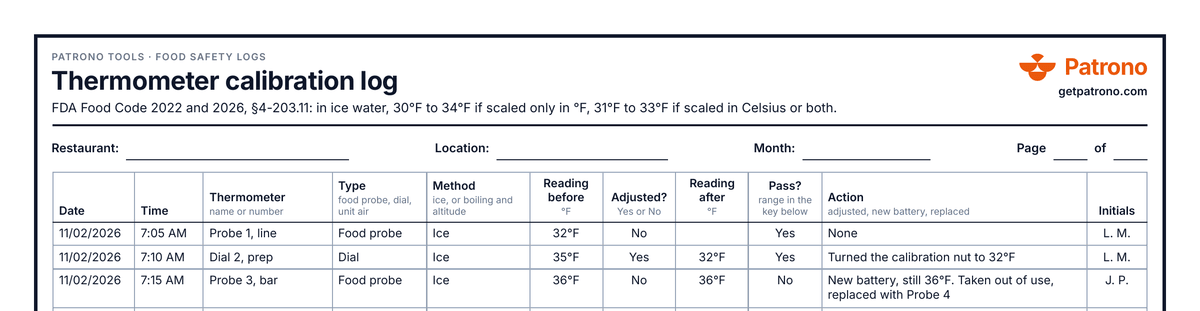
The log
One line per thermometer and check: the reading in ice water before and after any adjustment, pass or fail, and what you did. Enter your email and we send you the fillable PDF and the Word file, Letter size.
Thermometer calibration log
FDA Food Code 2022 and 2026, §4-203.11: in ice water, 30°F to 34°F if scaled only in °F, 31°F to 33°F if scaled in Celsius or both.
Location: ____________________________
Month: ____________
| Date | Time | Thermometer name or number | Type food probe, dial, unit air | Method ice, or boiling and altitude | Reading before °F | Adjusted? Yes or No | Reading after °F | Pass? range in the key below | Action adjusted, new battery, replaced | Initials |
|---|---|---|---|---|---|---|---|---|---|---|
| 11/02/2026 | 7:05 AM | Probe 1, line | Food probe | Ice | 32°F | No | Yes | None | L. M. | |
| 11/02/2026 | 7:10 AM | Dial 2, prep | Dial | Ice | 35°F | Yes | 32°F | Yes | Turned the calibration nut to 32°F | L. M. |
| 11/02/2026 | 7:15 AM | Probe 3, bar | Food probe | Ice | 36°F | No | 36°F | No | New battery, still 36°F. Taken out of use, replaced with Probe 4 | J. P. |
The first three lines are examples.
Reviewed by (person in charge): ___________________________
Keep this check in one app
In Patrono, the ice-water test is on the Weekly checks list that a new US account starts with. Your team ticks it on the phone, and each finished list shows who completed it. Add the check to any list you run more often. Start with 14 days. $0 today, cancel before day 15 and nothing is charged.
Frequently asked questions
What does it cost?
Nothing. Enter your email and we send you the files.
How often should food thermometers be calibrated?
The Food Code sets no interval: food thermometers are calibrated per the manufacturer's specifications, as often as needed to keep them accurate (FDA Food Code 2022 and 2026, §4-502.11(B)). New York City's guide says daily. Good practice elsewhere is daily or at the start of each shift, and after a drop.
What temperature should a thermometer read in ice water?
32°F. A food thermometer scaled only in °F has to be accurate to ±2°F, so in ice water it should read 30°F to 34°F. One scaled in Celsius or in both has to be accurate to 1 degree Celsius (±1.8°F), so 31°F to 33°F on a whole-degree reading (FDA Food Code 2022 and 2026, §4-203.11). Outside that, adjust it or take it out of use.
How do you calibrate a food thermometer?
Stir crushed ice and clean water to a slush in a deep container. Put the stem in at least 2 inches without touching the sides or the bottom, wait about 30 seconds and read it against 32°F. On a dial thermometer, turn the calibration nut to 32°F with the stem still in the slush. On a digital one, press reset or change the battery and test again, or replace it.
What is the ice point method of calibrating a thermometer?
It checks a thermometer against ice water, which is 32°F. New York City's calibration guide calls it the more common method and says to use it unless ice is unavailable. The other is the boiling-point method: 212°F at sea level, lower at altitude.
Do you have to calibrate a digital thermometer?
Check it the same way, in ice water. Many cannot be adjusted: New York City's guide says most digital stem thermometers cannot be calibrated and must be returned to the manufacturer. If a digital thermometer reads more than 2°F off after a reset or a new battery, take it out of use and replace it.
When should a food thermometer be calibrated?
At the times you set, and also after it is dropped, after it goes from hot food to frozen food or another extreme temperature change, and whenever a reading looks wrong. Inspectors compare their thermometer with yours and may ask your staff to show how they calibrate (Annex 5).
Can I keep this check in an app?
Yes. In Patrono, the ice-water test is on the Weekly checks list that a new US account starts with. Your team ticks it on the phone, and each finished list shows who completed it. Add the check to any list you run more often.