Tools
Recipe costing template in Excel and PDF.
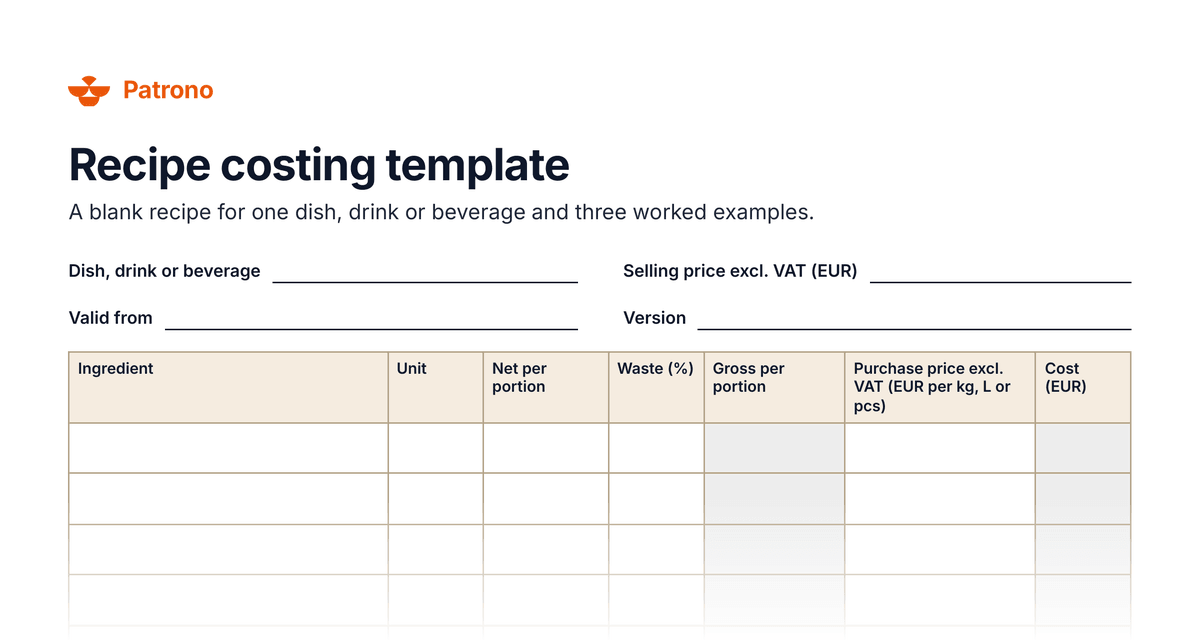
Six columns and formulas that work out gross quantity, cost and food cost on their own. With the blank recipe you get three examples: pasta with salmon, pizza and coffee with milk.
It arrives in your inbox within a minute.
What a recipe is
A recipe lists every ingredient of one portion with its net quantity, waste, gross quantity and purchase price. It tells you what a portion costs and what the food cost of a dish, drink or beverage is against its selling price.
In Croatia a recipe is also a legal obligation for every dish, drink and beverage (Hospitality Industry Act, Article 10(1)(4)). It has to be on the premises during opening hours, and you show it to a guest who asks for it. What the law requires and the fines.
Six columns and one that calculates itself
Each row is one ingredient. You fill in the white cells, the template calculates the grey ones.
- Ingredient, as you buy it from the supplier.
- Unit: g or ml against a price per kilogram or litre, pcs against a price per piece.
- Net per portion, what ends up on the plate or in the glass.
- Waste as a percentage, what is lost in cleaning, trimming and preparation.
- Gross per portion, what leaves the storeroom. The template calculates it.
- Purchase price excluding VAT, from the latest supplier invoice.
The seventh column, the ingredient's cost per portion, calculates itself too. Below the table are the cost of the portion, the food cost and the margin.
How to fill in the template
- Enter the dish, drink or beverage and its selling price excluding VAT.
- For each ingredient enter the unit, the net quantity per portion and the waste as a percentage. Find the waste by weighing the raw product before and after cleaning.
- Copy the purchase price excluding VAT from the latest invoice, per kilogram, litre or piece.
- For oil, salt, spices and garnish add one flat-rate line: unit pcs, quantity 1, and the flat amount as the price.
- Enter the date the recipe applies from and its version. When something changes, copy the sheet into a new version and keep the old one.
The formula
- Gross = net / (1 - waste / 100)
- Cost = gross x purchase price per unit
- Cost of the portion = sum of the costs of all ingredients
- Food cost % = cost of the portion / selling price excl. VAT x 100
If you only know the price including VAT, divide it by 1.13 for food or by 1.25 for drinks and beverages (Croatian VAT Act, Article 38).
The template rounds gross quantities to a whole gram or millilitre and costs to the cent, the same as when you cost a recipe by hand.
Example: tagliatelle with salmon
The first example from the template. The prices are an example, yours come from your invoices.
| Ingredient | Net | Waste | Gross | Purchase price | Cost |
|---|---|---|---|---|---|
| Tagliatelle, dry | 120 g | 0% | 120 g | 2.40 EUR/kg | 0.29 EUR |
| Salmon fillet | 100 g | 12% | 114 g | 18.00 EUR/kg | 2.05 EUR |
| Cooking cream | 80 ml | 0% | 80 ml | 3.20 EUR/L | 0.26 EUR |
| Red onion | 20 g | 10% | 22 g | 1.50 EUR/kg | 0.03 EUR |
| Parmesan | 15 g | 0% | 15 g | 22.00 EUR/kg | 0.33 EUR |
| Butter | 10 g | 0% | 10 g | 9.00 EUR/kg | 0.09 EUR |
| Oil, salt, pepper, parsley | flat | 0.12 EUR | |||
| Total per portion | 3.17 EUR |
The portion costs 3.17 EUR. At a selling price of 12.50 EUR excluding VAT the food cost is 25.4% and the margin per portion is 9.33 EUR.
The template also has a pizza margherita, food cost 16.7%, and a coffee with milk, food cost 20.0%. Drinks and beverages need a recipe too, not just dishes.
Frequently asked questions
Is a recipe mandatory in Croatia?
Yes. The Hospitality Industry Act (Zakon o ugostiteljskoj djelatnosti), Article 10(1)(4), requires a recipe for every dish, drink and beverage, service according to it, the recipe on the premises during opening hours and shown to a guest on request. The fine is 330 to 2,650 EUR for a company or sole trader (Article 47).
Are there prescribed recipes for hospitality?
No. The law does not prescribe ready-made recipes for dishes or drinks, it requires the operator to set them. The decisions on the allowed level of shrinkage, spillage, spoilage and breakage (HOK, NN 27/2024, corrected in NN 39/2024, and HGK, NN 80/2024) set how much shortage is not taxed. They are not recipe rules, but their rates are a useful reference for waste.
Can a recipe be kept in Excel or on a phone?
The current act does not mention the form of a recipe. It requires the recipe on the premises during opening hours and shown to a guest on request. The draft of a new act (P.Z.E. 315) explicitly allows a digital form, with the recipe shown to a guest in physical form. Until it becomes law, a printout on the premises is the safest choice.
How is the gross quantity calculated?
Gross is net divided by (1 - waste / 100). For 100 g of salmon with 12% waste the gross is 114 g. That much salmon leaves the storeroom for one portion, so the cost is calculated from the gross quantity.
Is food cost calculated with or without VAT?
Without. If you are VAT registered, compare the purchase price and the selling price without VAT. When you only know the menu price, divide it by 1.13 for food or by 1.25 for drinks and beverages (Croatian VAT Act, Article 38).
How often should a recipe be updated?
Whenever a purchase price, a quantity or the preparation changes. Keep the old version with the date it applied until, and give the new one the date it applies from. That is why the template has fields for the date and the version.
What next
The template handles one dish. Patrono handles the whole menu.
Patrono links recipes and supplier prices. When you enter a new ingredient price, the cost and margin of every dish that uses it are recalculated, so a price change shows up across the menu.